Europe is a continent purpose-built for visual storytelling. Within a few hours' flight, you can move from the sun-bleached white walls of the Greek islands to the moody, mist-shrouded highlands of Scotland, from the geometric precision of Barcelona's architecture to the wild, wind-carved coastline of Ireland's Cliffs of Moher. This visual diversity makes European destinations some of the most rewarding subjects for AI-generated travel content. Here are ten that consistently produce exceptional results.
1. Santorini, Greece
Santorini might be the single most recognizable destination in travel photography, and for good reason. The contrast between the white Cycladic architecture and the deep blue Aegean Sea creates a natural color palette that's almost impossible to get wrong. The caldera cliffs add dramatic vertical composition opportunities, and the sunsets over the volcanic islands are genuinely among the most spectacular on earth.
What makes Santorini particularly effective for AI generation is how well-defined its visual identity is. A prompt like "Santorini blue-domed church overlooking the caldera at golden hour, warm light on white walls, Aegean Sea below" produces immediately recognizable, emotionally compelling imagery. Experiment with perspectives: street-level shots through narrow alleys, elevated views of Oia from above, and wide panoramas of the caldera at different times of day.
2. Venice, Italy
Venice exists in a state of perpetual visual poetry. The interplay of water and architecture, the reflected light dancing on palazzo walls, the intimate scale of bridges and canals — it's a city that rewards every perspective and every lighting condition. Dawn, when the canals are glass-calm and the light is soft pink, produces an entirely different mood than night, when the city glows with warm window light reflected in dark water.
The gondolas are iconic but not the only visual story Venice offers. Try generating images of the quieter sestieri (neighborhoods) away from the tourist landmarks, where laundry hangs between buildings and cats sleep on window ledges. Or go grand with the Piazza San Marco at blue hour, the Basilica's gold mosaics catching the last light. Venice is endlessly generative because it's endlessly photogenic.
3. The Amalfi Coast, Italy
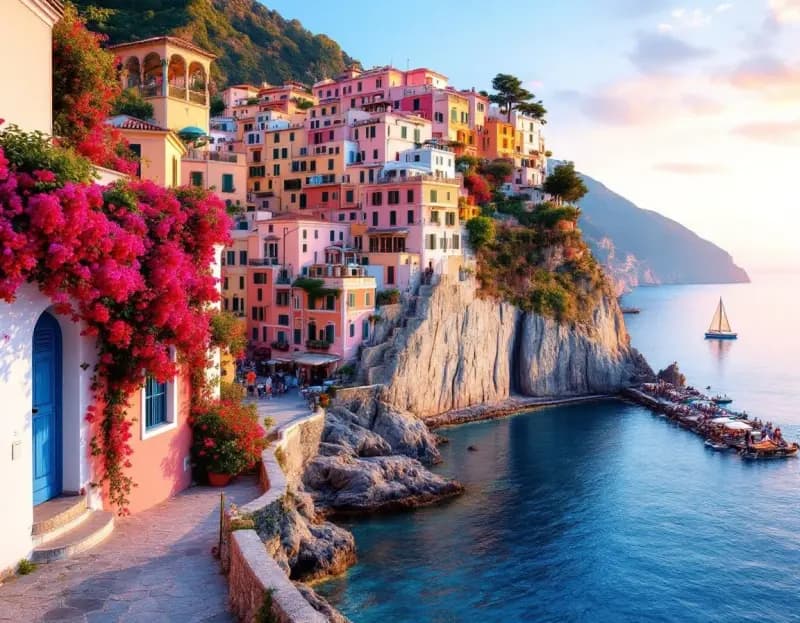
Where Santorini is cool whites and blues, the Amalfi Coast is warm pastels and vivid Mediterranean color. Positano's cascade of terracotta, pink, and yellow buildings tumbling down to the sea is one of Europe's most visually dramatic scenes. The winding coastal road, the lemon groves, the cliff-edge restaurants — every element contributes to a visual story of la dolce vita.
For AI generation, the Amalfi Coast works best when you embrace its color. Prompts that specify "colorful Mediterranean buildings," "bougainvillea-draped terraces," and "azure sea" tap into the palette that makes this coastline instantly recognizable. Aerial views are particularly striking, showing the full drama of buildings clinging to near-vertical cliffs above an impossibly blue sea.
4. Paris, France
Paris is photography's eternal muse. The city's appeal lies not just in its landmarks but in its atmosphere — the way morning light filters through plane trees along the Seine, the warm glow of a corner brasserie at dusk, the geometric precision of Haussmann boulevards radiating from the Arc de Triomphe. It's a city with layers upon layers of visual stories.
For AI-generated content, Paris rewards specificity. Rather than generating generic Eiffel Tower shots (though those work too), explore the neighborhoods. The cobblestoned streets of Montmartre at dawn. The bookstalls along the Quai de la Tournelle with Notre-Dame in the background. The pastel macarons in a patisserie window on the Rue du Bac. These smaller, more intimate scenes often produce more engaging content than the obvious landmarks because they feel like insider discoveries.
5. Hallstatt, Austria
Hallstatt is the quintessential fairy-tale European village — a cluster of alpine houses reflected in a mirror-still lake, ringed by dramatic mountain peaks. Its visual appeal is almost absurdly perfect, which is why it's become one of the most photographed villages in Europe and one of the most reliable subjects for AI travel imagery.
The classic Hallstatt composition is the lakeside view with the church spire as a focal point, ideally at dawn when the lake surface is perfectly still and mist clings to the mountains. But don't stop there — the village's narrow streets, the salt mine above, and the autumn colors of the surrounding Dachstein range all produce compelling imagery. Seasonal variations work particularly well: snow-covered Hallstatt in winter feels like a Christmas card come to life.
6. Barcelona, Spain
Barcelona offers something that few cities can match: a collision of natural beauty and architectural audacity. Gaudí's organic, fantastical buildings — the Sagrada Familia, Park Güell, Casa Batlló — look like they were designed specifically for AI generation, with their surreal curves, mosaic surfaces, and dreamlike proportions. Pair them with Barcelona's Mediterranean light and you have a visual playground.
Prompts that reference specific Gaudí structures tend to produce extraordinary results because the architecture is so visually distinctive. Try "Interior of Sagrada Familia with stained glass light pouring through windows, forest-like columns, warm golden and cool blue light" for an image that captures the cathedral's otherworldly atmosphere.
7. The Scottish Highlands
For moody, atmospheric content, nowhere in Europe competes with the Scottish Highlands. Brooding mountains, wind-swept moorlands, ruined castles emerging from mist, and lochs that reflect the ever-changing sky — the Highlands offer a dramatically different aesthetic from the sun-drenched Mediterranean destinations that dominate travel feeds, which is exactly what makes them valuable for content differentiation.
The Highlands reward prompts that lean into atmosphere. Words like "misty," "dramatic," "moody," "ancient," and "wild" produce images with the brooding, romantic quality that defines the region. The Glen Coe valley, the Isle of Skye's Fairy Pools, and the Jacobite steam train crossing the Glenfinnan Viaduct are particularly effective subjects.
8. Dubrovnik, Croatia
Dubrovnik's walled Old Town is one of Europe's most visually compact destinations — a tight labyrinth of terracotta rooftops, stone streets, and blue-shuttered windows, all contained within massive medieval walls with the Adriatic Sea as a backdrop. The view from the city walls at sunset, looking down over the rooftops toward the harbor, is one of Europe's most reliably stunning compositions.
AI generation captures Dubrovnik's visual density particularly well. Prompts that mention "terracotta rooftops," "medieval stone walls," "Adriatic Sea backdrop," and "warm Mediterranean light" consistently produce images that convey the city's unique character. The combination of historical architecture and natural coastal beauty gives every image depth and interest.
9. The Swiss Alps
Few landscapes on earth match the Swiss Alps for pure visual grandeur. The scale is overwhelming — ice-capped peaks towering above green valleys dotted with chalets, waterfalls cascading from impossible heights, mountain railways winding through tunnels carved from solid rock. Every perspective offers something extraordinary.
The Alps are remarkable for their year-round versatility. Summer produces lush green meadows with wildflowers and dramatic thunderclouds. Autumn brings golden larches against early snow on the peaks. Winter offers pristine snow-covered villages and crystalline blue skies. Spring brings the melt, with waterfalls at full force and the first flowers pushing through retreating snow. Each season has a distinct visual personality, giving you four completely different content themes from a single destination.
10. Bruges, Belgium
Bruges is Europe's best-preserved medieval city, and its visual charm lies in its intimacy. Cobblestone streets wind past gabled houses reflected in mirror-still canals. Horse-drawn carriages cross arched stone bridges. The Belfry tower rises above a main square lined with guild houses whose stepped facades look like they belong in a storybook illustration.
What makes Bruges particularly effective for AI content is its cohesive visual identity. The city looks like a single, curated composition rather than a random collection of buildings. This consistency means that almost any prompt set in Bruges produces an image that feels harmonious and aesthetically complete — a quality that translates directly into high-performing social media content.
Tips for European Destination Content
European destinations benefit enormously from seasonal specificity in your prompts. Don't just generate "Santorini" — generate "Santorini in late September, soft autumn light, fewer tourists." The seasonal context adds authenticity and gives your content a temporal dimension that makes it feel more like a genuine travel recommendation and less like a generic postcard.