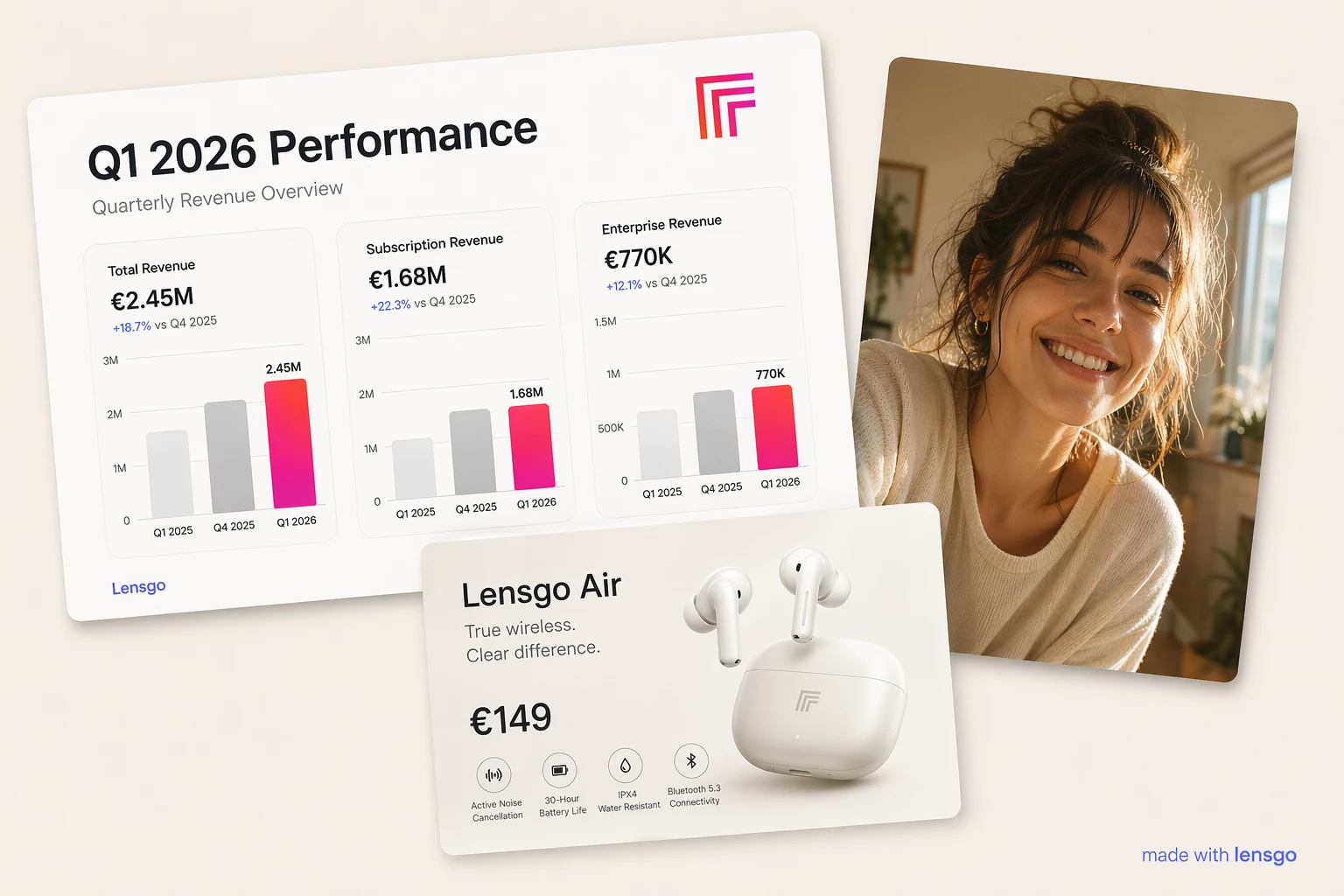
Seedance 2.0 vs Arcads, Creatify & HeyGen: The Best AI UGC Ad Generator in 2026
Performance marketers in 2026 face an awkward reality: TikTok and Meta want fresh, creator-style video every week, audiences ignore anything that looks polished or staged, and hiring a dozen real creators to churn out testing variants is slow and expensive. The answer most teams have landed on is AI UGC ad generation — software that produces creator-style product video on demand from a product image and a short brief.
This post compares Seedance 2.0 on LensGo against three of the most-searched AI UGC tools — Arcads, Creatify, and HeyGen — across the dimensions that actually matter for paid social: native audio support, product-image input, actor library breadth, batch variation, aspect ratios, and price. We'll also walk through the five-step LensGo workflow that turns one product photo into a TikTok-ready 9:16 ad, and finish with a candid look at where AI UGC still falls short so you can plan creative tests with realistic expectations.
TL;DR
Why UGC matters in 2026
User-generated content has dominated paid social for several years for one reason: viewers scroll past anything that looks like an ad. Native creator-style video — handheld, vertical, conversational, with on-screen captions — outperforms studio-shot brand creative on TikTok, Reels, and Shorts in nearly every category Meta and TikTok publish data on. The visual grammar of UGC (eye-line shots, daylight color temperature, slight handheld jitter, direct address) signals "real person, real opinion" rather than "agency-produced advertising message," and that signal is now worth a measurable lift in click-through and view-through rate.
The catch is volume. Algorithm-driven feeds reward freshness, so creative needs to be replaced weekly — sometimes daily for the largest spenders. Hiring a single creator to film five variants of a product video typically costs $300–$2,000 per round and takes a week or more, with a real risk that none of the variants test well and the whole spend has to be repeated. For a DTC brand running A/B tests on six SKUs across three audiences, that's an unsustainable line item, and it's the reason agencies and in-house performance teams have been the earliest adopters of AI UGC tools.
AI UGC tools collapse the same workflow from a week to an afternoon — write a brief, pick an actor, pick an aspect ratio, and ship. The category is now crowded enough that "best AI UGC video generator" is one of the higher-volume search queries in the AI ads space. The four tools we'll compare here are the ones that consistently come up in head-to-head evaluations: Seedance 2.0 (the model behind LensGo's UGC studio), Arcads, Creatify, and HeyGen.
What Seedance 2.0 actually is
Seedance 2.0 is a video generation model from ByteDance, released in 2026 as the successor to the original Seedance and Seedance Lite. It supports text-to-video and image-to-video, generates clips from 5 to 15 seconds at 480p or 720p, and outputs in any of six aspect ratios — 9:16, 1:1, 16:9, 4:3, 3:4, and 21:9. The 9:16 vertical mode is the one that matters for paid social; the others are useful for repurposing the same brief into landing-page hero video, YouTube thumbnails, or display-network ad creative.
The feature that sets Seedance 2.0 apart from earlier generations of AI video — including most of the competing UGC tools below — is native synchronized audio. Instead of rendering a silent video and stitching a voice-over track in post (which is how most AI UGC tools work today), Seedance 2.0 generates the audio as part of the same forward pass. That means lip movement, ambient sound, and on-camera dialogue land in sync without manual alignment, and the audio inherits the same visual mood as the shot — softer in a lifestyle scene, punchier in a hook + demo. It's a small architectural difference with a large practical payoff: less editing, fewer "AI-looking" tells, and creative that fits TikTok's and Meta's native-feel bar more easily.
LensGo wraps Seedance 2.0 in a UGC-ad pipeline (more on that next). The model is also available standalone in LensGo's general video studio if you want raw text-to-video or image-to-video without the UGC scaffolding, and it sits next to other ByteDance models like Seedance 2.0 Fast for cheaper drafts.
How LensGo turns Seedance 2.0 into a UGC ad pipeline
The raw Seedance 2.0 model is powerful but generic — give it a vague prompt and you'll get a vague clip. The LensGo UGC studio at /ai-ugc-video-generator adds five layers on top of the model that turn it into a UGC ad pipeline:
The full flow from "upload product image" to "TikTok-ready MP4 in hand" is five clicks and one short brief. The video itself is rendered by Seedance 2.0; everything else is the studio scaffolding around it.
Seedance 2.0 vs Arcads vs Creatify vs HeyGen: feature comparison
| Capability | Seedance 2.0 on LensGo | Arcads | Creatify | HeyGen |
|---|---|---|---|---|
| Native synchronized audio | ✅ | Voice-over only | Voice-over only | Voice-over only |
| Product image → ad (direct upload) | ✅ | Limited | ✅ | Limited |
| AI actor library | ✅ 50+ (free preview) | ✅ 300+ | ✅ 700+ | ✅ 100+ |
| Custom avatar | ✅ 5 credits | Paid plans | Paid plans | Paid plans |
| Batch variations | ✅ ×3 per request | ✅ | ✅ | Limited |
| Aspect ratios | 9:16 / 1:1 / 16:9 / 4:3 / 3:4 / 21:9 | 9:16 / 1:1 / 16:9 | 9:16 / 1:1 / 16:9 | 9:16 / 1:1 / 16:9 |
| Watermark-free on paid | ✅ | ✅ | ✅ | ✅ |
| Starting price | From $2/video (pay-as-you-go, 480p draft tier) | $110/mo subscription | $39/mo subscription | $29/mo subscription |
| Pay-as-you-go credits | ✅ | ❌ | ❌ | Limited |
A few honest caveats on this table:
When to use which tool
Each of these tools optimizes for a slightly different buyer. Here's a fair read of when each makes sense.
Use Seedance 2.0 (LensGo) when
You need native-audio video (not a voice-over dub on a static avatar), you're testing creative on a low-or-spiky volume schedule and don't want a monthly subscription floor, you have product images you want composited directly into the shot, or you also need image generation, headshots, product photography, or other creative tools in the same workspace. The UGC studio sits next to LensGo's image, video, and editing tools — useful if you're running a one-person creative team or a small in-house performance shop.
Use Arcads when
You're a performance-marketing agency or DTC brand running high weekly UGC volume (50+ videos per month) and the per-video economics on Arcads' subscription plans beat pay-as-you-go credits at your spend level. Arcads has a deeper actor library and is one of the more established names in the category, which can matter for procurement and long-running enterprise relationships.
Use Creatify when
You want the largest actor library and you specifically value the breadth of demographics and voice profiles. Creatify also offers a strong product-image-to-video flow and is competitive on starter pricing — it's a reasonable default if "more actors" is your top criterion or if you're producing for international markets and need accent and language coverage.
Use HeyGen when
Your use case leans more toward AI avatars for explainer video, training content, or corporate presentations than scroll-stop UGC ads. HeyGen has the largest cross-over user base for B2B avatars and has been investing heavily in custom-avatar quality. It's adjacent to UGC rather than dead-center on it; many marketing teams use HeyGen for course content and Seedance/Arcads/Creatify for ads.
How to make a UGC ad with Seedance 2.0 in 5 steps
The end-to-end workflow on LensGo:
For systematic testing, enable batch ×3 at step 5 — you'll get three variations of the same brief in one request, which is how most teams structure A/B tests on creative.
Pricing: cost per UGC video
LensGo's UGC tool charges credits per generation, priced by both duration and resolution:
480p draft tier — built for fast iteration before committing to a final render:
720p final tier — full quality for paid ad campaigns:
Add-ons:
Credits come from any LensGo Pro plan or one-time credit packs. UGC starts from around $2 per video at the cheapest tier (5s @ 480p, standard pack pricing), which is competitive with the per-unit cost on every subscription plan in the comparison above — and you don't pay anything in months when you don't generate, which matters for seasonal businesses, agencies between client engagements, and anyone running discrete creative-test sprints.
The competitor tools sell on a different model: monthly subscriptions starting around $29 (HeyGen), $39 (Creatify), and $110 (Arcads). At low and irregular volumes, pay-as-you-go credits are usually the better deal on absolute cost. At very high volumes (50+ videos/month, every month), a subscription plan typically wins on per-unit cost — in which case all four tools become roughly comparable on cost and the decision shifts to feature fit (audio, actor library, brand kit, integrations).
Best practices for AI UGC ads that actually convert
A working AI UGC pipeline doesn't guarantee converting creative. The same rules that apply to human-made UGC apply here:
Limitations and honest caveats of AI UGC video
AI UGC ads are good enough to test in market today. They're not yet good enough to replace every human-made variant, and pretending otherwise will lose you ad spend. A few honest limits to plan around:
None of these are dealbreakers; they're guard rails. Treat the first week of running any new AI UGC tool as a calibration period — generate a dozen variants, look closely at where the model breaks, and write your briefs to avoid those failure modes.
Pricing and feature data in this post reflects each provider's public pricing as of May 2026 and may change. Verify current rates on each provider's site before final purchasing decisions.
Try Seedance 2.0 yourself on LensGo — open the AI UGC video studio or browse all video tools at /tools/ai-video-generator.